
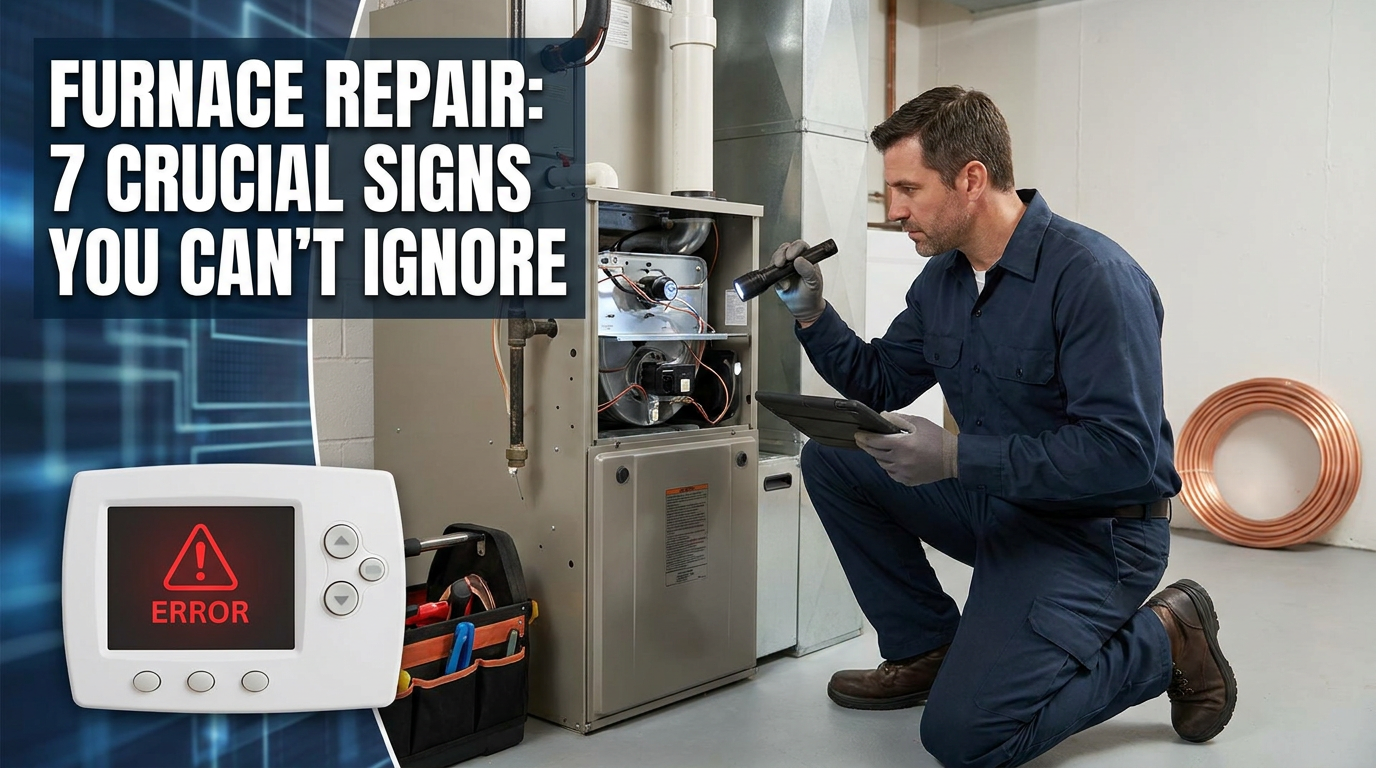
The mercury dips below freezing in West Valley City, and suddenly, your home feels less like a sanctuary and more like a high-altitude tent. This isn't just an inconvenience; it's a critical failure of your home's most vital winter system. Too many homeowners shrug off early warning signs, only to find themselves shivering in the dark, facing emergency repairs and exorbitant bills. A furnace doesn't just spontaneously combust into disrepair; it whispers, groans, and sometimes outright screams for attention long before it gives up the ghost. Ignoring these signals is not only uncomfortable but potentially dangerous and certainly expensive.
Think of your furnace as the heart of your home's comfort system. When it starts to show symptoms, early diagnosis is paramount. Waiting for a complete breakdown is like ignoring chest pains until you're in the emergency room. We've seen it time and again across Salt Lake County: a small, easily fixable issue metastasizes into a full-blown system failure, often at the worst possible moment – the coldest night of the year. Don't let that be your story.
1. The Symphony of Strange Noises: Beyond a Gentle Hum
A healthy furnace operates with a relatively quiet hum, a steady mechanical whisper that signifies its efficient operation. But what happens when that hum morphs into a cacophony of unsettling sounds? Suddenly, your basement or utility closet sounds like a tin can full of marbles, or worse, a grinding metal shop. This isn't just an auditory annoyance; it's your furnace trying to tell you something is fundamentally wrong.
We're talking about clanking, banging, whistling, scraping, or even a persistent screech. A clanking sound often points to a loose or broken component, perhaps a fan blade hitting something, or a motor bearing on its last legs. A high-pitched screech could indicate a worn-out belt or a failing motor. Whistling might be a sign of restricted airflow, often due to dirty filters or blocked vents. Each distinct sound is a symptom, a diagnostic clue. Ignoring these mechanical cries for help will inevitably lead to exacerbated damage, potentially turning a simple part replacement into a full system overhaul. Identifying the precise sound can even help a qualified technician, who should always be insured and certified, pinpoint the problem more quickly, saving you diagnostic time and money.
2. The Great Chill: Uneven Heating and Cold Spots
You walk from your living room into the kitchen, and it feels like you've entered a different climate zone. One room is toasty, the next is frigid. This isn't just a quirky architectural feature; it's a glaring red flag that your furnace is struggling to distribute heat evenly. This symptom is particularly frustrating because your furnace might be running constantly, guzzling fuel, yet failing to deliver consistent comfort.
Uneven heating can stem from a multitude of issues. It could be as simple as blocked vents or an improperly balanced duct system. However, it can also signal more complex problems like a failing blower motor that isn't pushing air effectively, or a furnace that's cycling on and off too frequently due to a faulty thermostat or heat exchanger issue. Imagine trying to heat a home with a leaky bucket; the energy is being spent, but the warmth isn't reaching where it needs to go. A professional inspection can uncover whether it's a minor adjustment or a precursor to a more significant breakdown, ensuring your entire Salt Lake County home remains uniformly comfortable.
3. The Unseen Threat: Rising Energy Bills
Your monthly utility statement arrives, and your jaw drops. Despite no significant change in outdoor temperature or thermostat settings, your heating costs have inexplicably skyrocketed. This isn't just bad luck; it's often the most subtle yet concrete sign that your furnace is operating inefficiently, essentially burning money.
A furnace that's working harder to achieve the same result is a furnace in distress. This inefficiency can be caused by a variety of factors: a clogged air filter forcing the system to overwork, a failing heat exchanger that isn't transferring heat properly, worn-out components, or even a deteriorating burner. A furnace that's losing its efficiency is like a car with a perpetually flat tire; it's still moving, but it's consuming far more fuel and stressing its components unnecessarily. Over time, these minor inefficiencies compound, leading to significant financial drain and accelerating wear and tear on the entire system. Tracking your energy bills is like taking your furnace's pulse; a sudden spike is a clear indicator that a check-up is overdue.
4. The Tell-Tale Smell: More Than Just Dust
When you first fire up your furnace after a long summer, a slight burning dust smell is common and typically harmless. However, if persistent or unusual odors emanate from your vents, it's time to pay serious attention. These aren't just unpleasant; they can be indicators of dangerous problems.
A metallic or burning smell, especially if distinct from the initial dust burn-off, could point to an overheating motor, electrical issues, or melting plastic components within the system. More critically, a smell resembling rotten eggs or sulfur is an immediate red flag for a natural gas leak. Natural gas is odorless, but utility companies add mercaptan, a harmless chemical, to give it that distinctive, pungent smell precisely for leak detection. If you detect this odor, evacuate your home immediately, do not operate any electrical switches, and contact your gas company and emergency services from a safe location. Other smells, like a musty or stale odor, might indicate mold or mildew growth in your ductwork, which not only affects air quality but can also be a symptom of excessive moisture within the system. Never dismiss an unusual smell; it’s a direct alert from your furnace.
5. The Constant Cycle: Short-Cycling Symptoms
Your furnace kicks on, runs for a few minutes, shuts off, and then almost immediately kicks back on again. This is known as "short-cycling," and it's a clear sign of trouble. A healthy furnace should complete a full heating cycle, running long enough to adequately warm your home before shutting down for a period.
Short-cycling is detrimental for several reasons. Firstly, it's incredibly inefficient, as the furnace expends the most energy during startup. Constantly starting and stopping puts immense strain on components, accelerating wear and tear and significantly shortening the system's lifespan. It's like driving your car in stop-and-go traffic all the time; it's harder on the engine than a smooth highway cruise. Causes can range from a dirty flame sensor, which incorrectly detects a flame and shuts down the system, to an oversized furnace for your home's square footage, or even a malfunctioning thermostat. Left unaddressed, short-cycling can lead to premature furnace failure and higher repair costs down the line.
6. The Yellow Flame: A Hidden Hazard
Take a moment to observe the color of the flame in your furnace's burner. A healthy, efficient furnace should exhibit a strong, steady blue flame. If you notice a yellow or orange flame, especially if it's flickering or appears lazy, it's a critical warning sign that demands immediate attention.
A yellow or orange flame indicates incomplete combustion, which can lead to the production of carbon monoxide (CO). Carbon monoxide is an insidious, odorless, colorless gas that is highly toxic and can be fatal. It's often referred to as the "silent killer" because its presence is undetectable by human senses. This issue is often caused by a dirty burner, a cracked heat exchanger, or insufficient oxygen supply. While a CO detector is a crucial safety device for every home, the visual cue of a yellow flame provides an earlier warning. If you see a yellow flame, turn off your furnace and call a qualified, insured HVAC technician immediately. This isn't a problem to defer; it's a potential life-threatening hazard.
7. The Aging Factor: When Time Takes Its Toll
Even the most meticulously maintained furnace eventually succumbs to the relentless march of time. Furnaces typically have a lifespan of 15-20 years, though this can vary based on usage, maintenance, and initial quality. If your furnace is approaching or has exceeded this age, it's inherently more prone to breakdowns and inefficiency, regardless of how well it's seemingly performing.
An older furnace might not exhibit one dramatic failure but a series of accumulating minor issues: frequent repairs, decreased efficiency, and a general inability to keep up with demand. As components age, they become less reliable. The heat exchanger might develop cracks, the blower motor might weaken, and electrical connections can degrade. While some minor components can be replaced, pouring money into an aging system often becomes a financial losing battle. At a certain point, the cost of ongoing repairs outweighs the investment in a new, far more efficient unit. A seasoned HVAC technician can assess your older furnace's overall health and help you determine whether it's more economical to repair or replace, offering a clear roadmap for your home's long-term comfort and safety in West Valley City.
Don't Play the Waiting Game
Ignoring these critical signs is not just an inconvenience; it's a gamble with your comfort, your wallet, and potentially, your safety. A proactive approach to furnace repair not only saves you from frigid nights but also prevents minor issues from escalating into expensive, emergency replacements. Regular maintenance is your best defense, but when these specific symptoms arise, it's time to call in the professionals.
In Salt Lake County, where winter temperatures demand reliable heating, ensuring your furnace is in peak condition is non-negotiable. Don't wait for the inevitable cold snap or the unmistakable smell of gas to prompt action. Pay attention to the subtle cues, the unusual noises, and the rising bills. A timely repair by a qualified, insured HVAC expert can extend the life of your system, restore efficiency, and most importantly, keep your home warm and safe. Prioritize your furnace's health, and it will continue to prioritize your family's comfort.